












Stop watching private equity and M&A tutorials. Start building real financial models every month—just like finance professionals do.


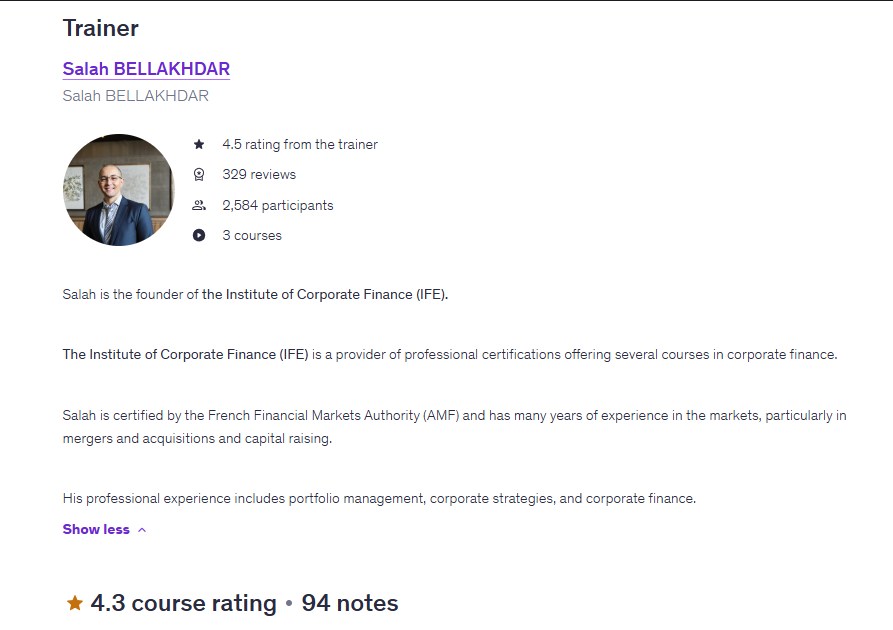
FRENCH PROJECT FINANCE PROFESSIONAL · FOUNDER OF IFE
Like hundreds of students every year, I was applying for private-equity analyst roles. I knew finance — DCF, comparables, valuation. I felt ready. Then a recruiter said: “Build me a three-statement model. Right now.”
I froze. I had a master’s in finance — and no one had ever taught me to build a real Excel model from A to Z. I didn’t get the role. And I understood that my degree wasn’t enough.
Books on financial modeling. Workshops. Thousands of euros invested in the one skill no one had bothered to teach me. I learned that building a model turns finance knowledge into a concrete decision tool.
My first real-world models: investment memos on private US companies. For the first time, my work was driving actual allocation decisions — read, and challenged, by professionals.
On a private-equity fund, I built the models used to support investor decisions in equity and bonds. Every model had to be robust. Every assumption had to defend itself. Today I model +20M€ solar projects financing in France.
I built IFE (www.institutdefinancedentreprise.com) and ListedModels to help finance professionals advance their careers by developing stronger financial modeling and analytical skills through structured, real-world case studies.
Level 10 — build a complete model live.
This is the difference: every month you get 1-3 real case studies built the way the best analysts actually work today.
Finance courses covering corporate finance, financial analysis and professional finance skills.
Let’s talk financial modeling, finance careers and how stronger practical skills can help you move forward in your career.
Each Listed Models case study follows a structured modeling process — from understanding the company and its operating drivers to building the financial statements, cash flows and valuation.
Understand the assignment, the company, the modeling objective and what you are expected to build.
Understand how the company makes money, its key activities, industry dynamics and relevant operating KPIs.
Review historical performance and identify the trends, relationships and financial characteristics that matter for the forecast.
Translate the business into measurable assumptions that will drive the forecast rather than relying on arbitrary growth rates.
Build revenue from the company's underlying commercial and operational drivers.
Model variable costs, fixed operating expenses, margins and the path toward operating profitability.
Model receivables, inventory, payables and the effect of operating growth on cash requirements.
Build the investment schedule and connect capital expenditure, fixed assets and depreciation.
Understand how funding requirements are financed and how debt, equity and liquidity interact with the model.
Integrate the income statement, balance sheet and cash flow statement into one connected forecast.
Convert the operating forecast into valuation outputs and understand how key assumptions affect the result.
Review model integrity, validate key outputs and step back to interpret what the completed model tells you about the business.
One framework. Different businesses. Each new case study applies the same modeling discipline to a different company, industry and set of operating decisions.
Watch the course conclusion and see how the full case study comes together from operating assumptions through the financial statements and valuation.
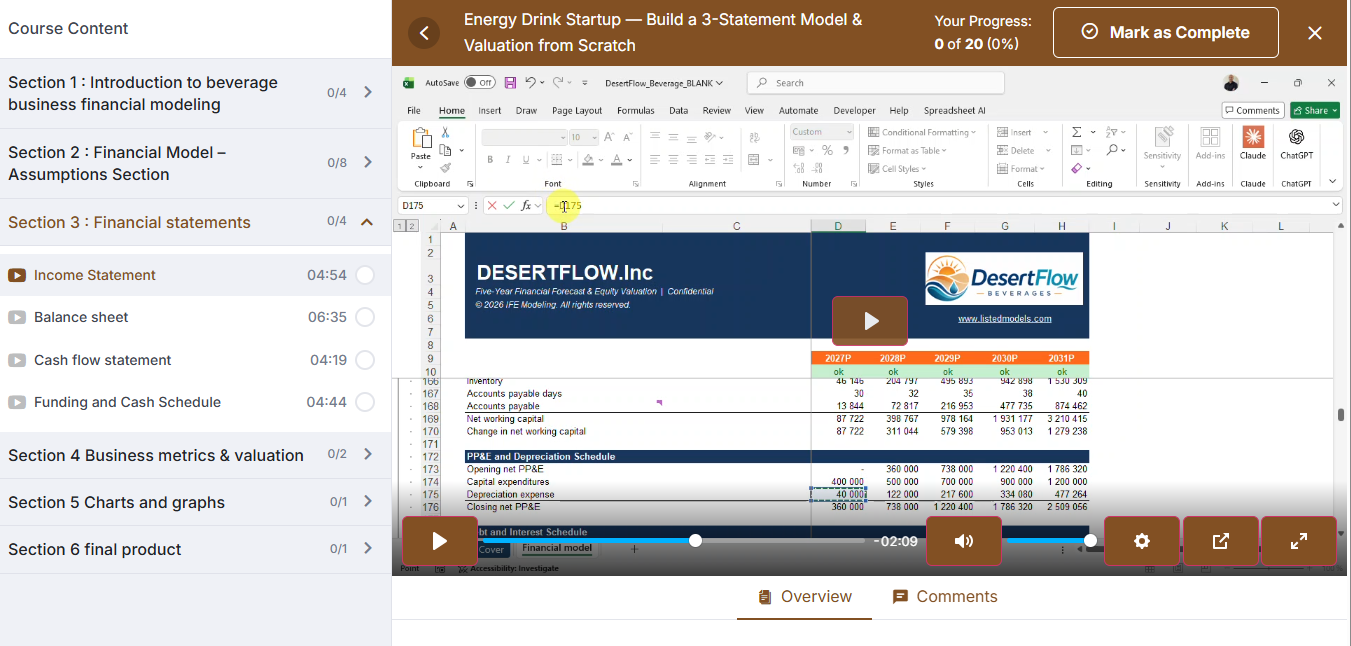
Work through each case study inside a structured learning environment. Follow the modules in order, watch the Excel walkthroughs and understand how the model develops from the business assumptions to the final outputs.
It’s a simple monthly subscription: $19,99/month, cancel anytime. You get immediate access to the current case studies and every new model as long as you’re subscribed.
If you know Excel basics (formulas, references) and core concepts (DCF, comparables), yes — this is where you level up. If those are brand new, learn them first, then come back.
A realistic case brief with the raw inputs, a blank starter Excel file, a step-by-step video walkthrough, the finished professional model to compare against, and the AI prompts used to speed up the repetitive parts.
Each case study runs from raw assumptions to a fully linked three-statement model, a transaction structure with debt schedules and returns (IRR / MOIC), a valuation and a one-page investor chart pack. Difficulty increases across the year.
Any recent version of Excel works (Microsoft 365, 2019 or later). Google Sheets can open the files, but some formatting and shortcuts are Excel-specific, so Excel is strongly recommended.
Yes — while you’re subscribed you can access the full library from your dashboard, including every case study released before you joined, and download the files anytime.
You can reach out directly and get help on the specific block that’s blocking you — a broken link in the cash flow, a circular reference, a debt sweep that won’t balance.
Yes you can ancel anytime you want from your learner dashbaord !
If, within 14 days of your first payment, you decide that Listed Models is not right for you, simply contact us and we will issue a full refund. No questions asked.
Our guarantee: the 14-day money-back guarantee applies to your first subscription payment. Refunds are returned to the original payment method used to subscribe.